Posts

Small Towns, Big Railroad

Image
The hustle and noise of big cities seems a far cry from the lonesome quiet that pervades the vast spaces between. Perhaps one of the greatest ways to experience this today is to ride one of the few remaining passenger trains across the great expanses of the West. Chicago bursts with activity on a early afternoon weekday departure. By next morning, trains like the Empire Builder find themselves out in the great seas of open prairie. The expanse under big skies is incredible, broken only by grain elevators and the small towns they stand over. The Milwaukee Road's journey across the West had all of these elements as well. Long and unbroken expanses of prairie grasses that were separated by small collections of houses and buildings. These little groupings, like Lennep, MT as seen above, made up the prairie towns on the Western Extension. Lennep had a small industry track for the collection of livestock, a school, church, and a few people. The snarl of large electric locomotives...
Progress

Image
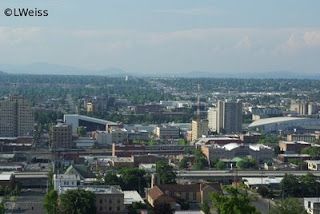
There's a sign at the airport in Spokane, WA that welcomes travelers to the "Inland Northwest."  Spokane must be the heart of this country as it's by far the largest city in the region.  It's a major stopping point for today's travelers along I-90 and a fascinating focus point for a great deal of the area history.   Spokane seemed the logical waypoint for many of the western railroads on their way from the Midwest to Seattle.  Among many other things, Spokane became a cross-roads for these companies.  The Northern Pacific, Great Northern, Union Pacific, and SP+S all had a presence here at one time.  That doesn't even take into account the various lines that were absorbed into the larger companies (like the interurban 'Spokane and Inland Empire' which became GN or the 'Spokane International' which rolled into the UP).  Railroad history is thick here in the heart of the Inland Northwest. There was a late entry into the city of Spokane as well...

Working on a Dream

Image
The Milwaukee Road is famous for a number of things, not the least of which is its bold electrification, famous electric locomotives, and that wonderful slogan, "America's Resourceful Railroad."  Huge trestles and long dark tunnels remain through the mountain passes to this day, reminding the 21st century of dreams from 100 years ago. Not as famous, but breathtaking in its own right is the Milwaukee's crossing of the great plains - the lands east of electrification.   The lands east of electrification are lands of Big Sky and open plains.  These are the lands of crystal blue skies and deepest black nights where grasses sway in summer breezes or stand stiffly in a frigid January coating of snow and ice.  Here on the plains the Milwaukee also rolled its trains across the Western Extension.  ABS signals stood in place along the single-track mainline to the bitter end, when dead freights were the order of the day and derailments averaged 1 per day across Montana.   Earlie...

White Christmas

Image
It was a cold winter day in Eastern Washington one Sunday morning, now several years ago. Loading the old suburban up with camera gear, I headed out to one of my favorite photo subjects, just to see a bit of snow fall on The Milwaukee Road. The snow was heavy and thick at Rosalia, but thinned as I worked my way west toward Rock Lake. At Pine City, the clouds broke and the weak winter sun glinted for just a few moments off the old Pine City elevators. It was a peaceful and quiet morning along the lines of America's Resourceful Railroad, I hope your holiday season finds moments of the same.

Ghosts of Christmas Past

Image
In the cold winter months of 1977, it was announced that the Milwaukee Road would file for bankruptcy. The date was December 19. The path to bankruptcy had been one in the making for many years, seemingly unavoidable, and without any large government loans or bailouts forthcoming. Perhaps the government was simply not in the mood to form a "Conrail West" made up of the struggling Rock Island and Milwaukee Road. Perhaps the lobbyists that seem to play such a prominent role in the workings of money and policy were simply better funded at the Milwaukee's major competitors. History records that the line's final winters were cold indeed. Locomotives were borrowed to supplement a dilapidated fleet and movements across the system reflected the deteriorated condition of the lines. The announcement of bankruptcy must have been a crushing blow to the people who relied on the Road to make a living. Perhaps it was expected, but the announcement from the managers to their em...

Big Iron

Image
There's not much argument when it comes to one aspect of the Milwaukee Road:  it built things on a large scale and to a high degree of quality. Spanning the valley at Tekoa, WA is an enormous steel trestle that bears witness to this fact.  For decades it lofted the Milwaukee's freights across the valley floor and the tracks of the Union Pacific in this small Eastern Washington town.  Here, and in many other locations like Tekoa, the Milwaukee "simply" built across the valley, dwarfing the small town and the Union Pacific branch in the process. Today the big iron of the Tekoa trestle stands as the easternmost portion of the John Wayne trail, although it is closed to the public.  The Union Pacific that existed beneath the Milwaukee's Pacific Coast Mainline is gone as well, leaving the old railroad town of Tekoa without any of the lines that supported it for so long.  The past isn't forgotten by this little town, however, as signs sporting large black silhouettes...

The Recurring Question

Image
What really happened out there?  In 1974, at the peak of traffic on Lines West, what really happened?  In the waning years of the seventies, what really happened?  I'm not sure, I wasn't there. My first brush with the Milwaukee Road came in the early 80s, from out the backseat window of an old red Suburban that occasionally crossed the Cascade Range on the way to Sand Point.  I knew nothing about it, except those trestles sure were neat.  One trip, I remember the trestle at Renslow had ties strewn about its approaches and I wondered 'why?' even as a small child.   The question still remains and remains unanswered - why?  From my chair in front of the computer, now a few thousand miles and a few decades away I try to imagine all of the forces that played on the fallen transcon.  Double-counted maintenance expenses in the last years of operation.  Maintenance left undone in 1975.  Electrics scrapped whose value to operation was well established.  A marathon of derailments...