Sunday, November 01, 2009

The Romance

It’s almost midnight in Pittsburgh this brisk November evening in 1996. My breath hangs in the air as I step out of a cab and walk quickly into Penn Station. The single escalator is moving the wrong direction so I take the stairs up to the old platforms. A lonely Amtrak diesel, number 310, is idled peacefully on a spur, retired for the night. As I wait on the platforms of Pittsburgh’s Penn Station I stare eastward, looking for the late Capitol Limited. Snowflakes slowly drift down through holes in the old train shed.

The Capitol pulls into the station one hour late lead by a new Genesis locomotive. 838 is its number and it leads a set of double-decked Superliner cars on an 800 mile sprint from the nation’s capital to the capital of the heartland. The stop in Pittsburgh is just one of many scheduled throughout the night before arrival in Chicago. The Capitol is nothing like an airplane or bus. You never meet the engineer, reasons for delays are guarded secrets, and the passenger is usually wrong or in the way. But to some, train travel still has its magic.

The Pittsburgh skyline and Golden Triangle slip away as 838 heads us west along the Ohio River and beside old US highways. Near Sewickley the falling snow makes the lights of Conrail’s massive Conway yard soft and diffuse.

The Capitol’s next stop comes at Alliance in the wee hours of the morning. No one is there waiting. Only a few parked cars, a tool shed, and a sign that reads “Chance takers are accident makers” greet the train. With no passengers on or off the Capitol is ready to head west but the snow has become too deep. The automatic switch machines are frozen and one of the crew must wade through the snow and throw them manually. His comment is well received, “someone owes me a cigar for that.”

Cleveland’s distinctive skyline rolls into view as the Capitol creeps its way into the city. Speeds are usually faster here but tonight there are twelve inches of snow on the ground, frozen switches, and long slow freight trains. Leaving town two hours late, we cross “Bridge 1.” This old lift bridge has seen many snowy nights like this one. Fifty years ago, a crack passenger train named the 20th Century Limited waited for a half hour at Bridge 1 while a novice bridge operator let a barge pass beneath it. Those were the days when trains like the 20th Century didn’t wait for anything and the operator was fired. Those were also the days when trains had sleeping cars called Pullmans and didn’t stop in Toledo or Pittsburgh for half an hour to unload mail and packages. But such is the progression of time and there are few on this train who know how different it used to be anyway.

The train is late enough out of Toledo that dawn breaks in western Ohio. The countryside is now distinctly Midwestern, full of harvested cornfields and gently rolling hills. The sun is rising and as the train races along at 80 it kicks fresh snow up and into the orange sky. For me, this is the romance and magic of railroading; a connection to the past and a forgotten soul of a nation. Chicago is still five hours to the west and we’ll pull in 3 hours late but it doesn’t matter, the trip has already been worth it.

Nighttime in Chicago is a beautiful collage of color and people. In Union Station the scene is more subdued. The stately marble and granite give the old Grand Concourse an impersonal and intimidating feeling, recalling times when the Pennsylvania Railroad called itself “The Standard Railroad of the World” and its pride was the Pullman only passenger train named the Broadway Limited. In 1902 the train was premiered in New York as the Pennsylvania Special just a short distance from the New York Central’s own premiere festivities, kicking off the storied 20th Century Limited. And so a great rivalry and race was born as the two legendary trains ran the gauntlet between New York and Chicago. The Century ran along the Water Level Route via Buffalo, Cleveland, and Toledo. By contrast the Broadway headed out across the Alleghenies to Pittsburgh and Ft. Wayne. The rivalry lasted until the late sixties when the Century was pulled from service, leaving only the Broadway to soldier on. Amtrak inherited the train in 1971 making it their own premiere eastern train and benchmark for quality service. It was the first train to get matching passenger cars in the seventies; a symbol of progress over the rainbow of colors Amtrak collected from the freight railroads. It survived Penn Central, Conrail, and the rise of the Capitol Limited to the position of “premiere eastern train.” But it couldn’t survive the budget cuts of 1995 and after 93 years of continuous service, the operation ended quietly in 1995.

A million years from streamlined Centuries and Broadways and just off the Grand Concourse in a small waiting room with worn brown carpet and plastic foliage, I stand with a small group of people. We are waiting for the call to board the last train in the station. Yesterday this train wasn’t here, in fact, not since The Broadway has there been a train to New York via Pittsburgh. Even though this train isn’t named the Broadway Limited, the schedule and train numbers are the same. Traditionally train 40, The Broadway, was the last train to depart Chicago and this new train, The Three Rivers, is set to pick up where the Broadway left off. Most passengers waiting with me aren’t aware this is a first run. Fewer are aware that it is the second coming of a railroad legend. I guess it’s understandable since unlike 1902 New York, there is no fanfare.

The train is going to make only one stop between Hammond and Pittsburgh in a little town called Nappanee, Indiana. With so few passenger cars and so many express cars, it looks more like a freight train than an old benchmark for quality service. Leaving Chicago on time behind two venerable F40 locomotives we make our quick stop in Hammond and leave Lake Michigan behind.

The single level Amfleet cars pitch and roll as we outpace the schedule across the dark northern Indiana countryside. The Three Rivers turns out to be a little train with an attitude all it’s own. People stay up all night and play cards in the cafe car but never ask for names; it doesn’t seem important. Farm houses with lighted windows and dark vacant towns with single blinking four way stops slip by outside the window, bearing silent testament to our passing. Unlike the previous night, snow is no problem and the Three Rivers pulls into Pittsburgh twenty minutes early. It’s good to have this train with us again. Pittsburgh is cold and gray and the first flakes of the next snow blow through the station platforms, hurried by a sharp and cutting wind. Only thirty hours have passed, but the ride on the Capitol Limited seems years away as I walk the length of the Three Rivers back into the station. Hailing a cab we pull away from Penn Station and leave 1000 miles and a new beginning behind.

Epilogue: The resurrection of a disbanded railroad icon is a rare thing indeed, but the Three River's time proved as limited as everything else. The abandonment of mail contracts in 2005 led to its demise in March of that year. I wasn't able to share in the last run as I had in the first; time had placed me far away in the lands of the western Hiawathas. Still, the memories of that snowy night and the crisp coolness of the Pittsburgh platforms remain vivid and heartfelt. God, has it really been 13 years?


Wednesday, October 21, 2009

The Sun Rises

One of the oft remarked places of note on the Milwaukee's line through Eastern Washington was the large wooden trestle near Pandora. It was a hidden treasure for those who ventured the Pacific Extension beyond the bounds of the electrified districts. This was dark territory and history recounts the accident here when two freights met head-on. These were the final months before the resourceful railroad became part of lore and legend.

Today, the large trestle near Pandora is gone. It has left a large cut in the sweeping curves and large embankments of the Pacific Extension's travels through the Palouse. Fading are the memories of that fatal accident now many years in the past. Recollections of the last runs of orange and black across the rolling Palouse fields are fading as well. Only the abandoned right of way is left to hint that something larger was here before.

These last runs and old sights that now seem so faded point to a larger, disconcerting truth. The things that pass from this place into finality are at best given passing notice. In reality, the sun rises the next day, people get up and go about living their lives, and the world continues on without. Many people and places have passed since the Resourceful Railroad in the west became the quiet memorial that defines it today. In an uncaring forwarding of time, it slips further and further into the fogs of the past and the sun rises on still another day. It takes special effort to recall and put context to the events and people of times past. The stories are deep and meaningful. If you choose to pursue them and take note of them, however, they can lead to something far larger. This is a true call which beckons us to remember what has come before. It requires sacrifice and perseverance so that the rising sun of another day will not simply be an uncaring and insignificant forwarding of time. Instead it will be used to ask, to seek, and to knock.

Thursday, October 01, 2009

Kingdom of Idols

In the shadows of the old U.S. 2 lane highway, a portion of the Milwaukee Road's Lines West sits basking in the hot summer sun. The nights are frigid here, but the days are hot and dry.

In many places, it seems one could simply relay the rails of America's final transcon. At Cyr, however, this bridge over the Clark Fork River is gone. One of the victims of the scrappers and the bankruptcy of days past.

The thoughtful quiet of Cyr pales in comparison to some of the remote sections of the Rocky Mountain division. Although US 10 has been relegated to a service road, its replacement is not far away. A few hundred feet to the south, just out of eyeshot but never out of earshot, lies the modern transcon: I-90. While in many ways a symbol of American success and personal freedom, it remains a reminder of the price of the Milwaukee's failure. The continuous noise of all season radials on concrete echo along the Clark Fork River while the best engineered railroad to the West sits as a historical marker.

The idols of the ages change from time to time, but it's not hard to determine what they are. We rest in one of entitlement and gratification, one that quickly moves beyond past accomplishments for which we have no personal use. Our current idols have plotted an interesting course that is just now coming into clearer focus. The destination does not always seem appetizing, but the howl of radials along the Clark Fork remind us of its coming.

Friday, September 18, 2009

Montana Skies

Skies tell a remarkable story in their ever changing features and moods. Sunsets in the summer often speak of a long day's field work in hot weather. Wintery moon rises in a clear sky speak of cold infinities. At one point the sky seems happy and celebratory, at another, somber and moody. The skies over the Milwaukee Road's west have revealed all of these and more.

Few remaining stretches of Lines West show their ties to the Milwaukee's unique early 20th century signature. While all of the western roads can boast of high bridges and long tunnels, the Milwaukee created a unique calling card in the form of its catenary. While the Northern Pacific was never far from the Milwaukee's western extension, it was never difficult to tell the two lines apart. As they made their way across Montana's ever changing landscapes, the wooden poles supporting the electric lifeline to Milwaukee power were a clear sign and symbol of the Resourceful Railroad. Railroad legend often links the electrification with the health of the railroad in general. Many associate the Milwaukee's ultimate demise with its decision in the mid seventies to eliminate electric operations. A review of fuel economy and fuel prices adds significant credibility to this argument: the electrics posed a significant cost savings compared to the diesels that replaced them. This author has noted the correlation in the past, referring to the Little Joes as Orange Canaries.

On a cool summer day, unlike may of the hot afternoons felt across the wide plains of Montana, one of the few catenary poles still stands. 35 years have passed since the last Joe passed beneath it. Almost 30 have passed since the railroad passed. With the old lineside poles keeping it company, it stands still as a signature left behind. The skies above on this cool day take a somber and quiet tone, fitting well the events that have transpired here.

Sunday, September 06, 2009

4 Years of Memories


From the archives, now four years back:
In the late winter of 1977 (December 19 to be exact), the last transcontinental railroad that was built in America filed for Chapter 11 Bankruptcy protection. Its lines across the mid-west and west lay in ruins as a result of a complicated and inter-twined series of events that, at best, are difficult to understand. The winter of 1979 would be its final winter and in 1980 The Milwaukee Road sold its Western Extension to scrapers from Terry, MT to Tacoma, WA. The company that emerged (with track only in the Midwest) would last only five more years before being sold to The Soo Line, thus completely ending the granger railroad that never really came to grips with being a large transcontinental route.

As a matter of fact, the 1970s weren't a happy time for railroads in general. At least up until the Enron fiasco, the record for most money lost in a single day by a corporation was held by the Penn-Central Railroad. The Rock Island Railroad would, like the Milwaukee, file for bankruptcy protection and be gone as a corporation by March 1980 and its occasionally rumored merger partner to the east, the Erie-Lackawanna, would be bankrupt and put under the wings of Conrail in 1979.

So what makes The Milwaukee Road special? Perhaps it is its bold and scenic route across the upper Mid-west and West that pits it against five mountain ranges. Perhaps it is its storied love affair with electrified operations through the Rockies and Cascades. Or perhaps it is the people and towns that it has left behind to wonder at its passing and marvel at the scale of its failure. For whatever the reason, the old road is fascinating to me and I'll post some more thoughts and history as I feel led.
It was an introduction to something I felt passionate about sharing: The Milwaukee Road and the journey it has been. Long dark tunnels, abandoned schools, old elevators, and lonely sunsets across the West. Again and again I found myself out along the line these past few years, desperately trying to photograph what was left behind. It has been a journey of a thousand miles, started with a single step.

These travels, however, have led me to more than just the Milwaukee itself. On occasion, I have been confronted with the realization that we are much smaller than we like to think, that there is something larger, something deeper beyond the noise that surrounds us. It remains a small quiet voice. It is a voice that lurks on the inside, pointing us onward or prodding us to look more closely at what we would normally miss. It is the voice that adds depth, character, and an important sense of reverence for things passed.

These travels have also found me taking in old sights and sounds beyond the scope of Lines West itself. Off the forgotten trails of the Hiawathas and Columbians lie the remains of other places from similar times. The photo above is one such place along the old Rock Island in Eastern Iowa. A wintery day and a cold sunset for a desolate CTC signal, left behind in the aftermath.

Now, with four years of Milwaukee Road under the belt, I am going to expand the scope of the blog for awhile. The Milwaukee will still be present without doubt, but other fallen flags and fallen places will join it in the coming months and, hopefully, years ahead. I hope you will enjoy the continuing journey for there is much to discover. The still quiet voice leads on.

Friday, August 28, 2009

Fading to Quiet

I remember well my first trip to see the logger in operation on the Milwaukee Road Elk River Branch. It wasn't so long ago, just a few years. Leaves on the bushes and deciduous trees were turning to shades of orange and red. The tamaracks adopted brilliant yellows against the green canopy of evergreens around them. The sky was blue and crystal clear and the crispness of a fall day was at hand.

The outbound train to Clarkia that day glinted off the St. Maries River as empty log cars made their way south to be loaded. It was a small, out of the way railroad located in beautiful Idaho wilderness on an amazing fall day. My slides from the day still show the brilliant colorful hues of the West at its finest.

The railroad itself was in immaculate shape. Heavy rail, rescued from the original Milwaukee mainline along the St. Joe River, was placed on the line's many curves. The trestles and bridges looked fantastic. This was a railroad that dripped Milwaukee history as well: Milwaukee crews still waved from the power and caboose. The sound of GPs that echoed from the canyon walls were the same that had plied the line when wearing black and orange many years before.

Now, just a few years beyond my first encounter with the logger, it seems that life may be coming to an end for these old trains. Rumors have swirled for awhile that Potlach was going to stop using the log trains and give up on the Milwaukee's Elk River Branch altogether. Recent activities and newspaper articles seem to bear this out. Storage cars have been removed from the line between Clarkia and Bovill and, it has been said, that the last loaded log trains have left the Clarkia log deck.

This summer was my most recent, perhaps last, visit to the Milwaukee's branchline to see it in operation. As always the track and equipment were immaculate, the crews friendly. The image above captures the power and caboose heading home in the long rays of a western evening sun. It was a warm day in the Idaho mountains, but the Kodachrome skies were most welcome. It was a nice way to say goodbye to another piece of the Resourceful Railroad. The railroad will continue to haul finished products from St. Maries to Plummer along the old Milwaukee mainline and that will keep some of the equipment and employees around. Perhaps, if the rails to Clarkia and log cars make it through the recession and into another diesel fuel spike, the final chapter may not yet be written. As it stands now, however, another piece of Lines West is quickly slipping away. The aged Milwaukee equipment, the waves from the caboose, and all of those journal bearings rolling down jointed rail are becoming memories and images of the past. It has been a pleasure and blessing to see them as they were.

Tuesday, August 25, 2009

Interesting Time

It is an interesting time we find ourselves in. Consider this: we are still able to look back at some of the things that defined the nation's growth and see them as they were. In another 50 years, these relics of past people, past towns, past lives will be truly gone. Another generation, perhaps two, will grow up in these old places and move out into the rest of the world. This movement has been ongoing for decades, but it has an accumulating effect. Little by little, many a bustling little town slowly becomes a quiet field of memory across America's frontier.

In 50 years, a trip along The Milwaukee Road and its Western Extension may still run along US 12, but how many more bridges will be missing? How many more miles of right of way tilled into the fields? How many old grain elevators will be left to mark an old settlement? How many will remember what was?

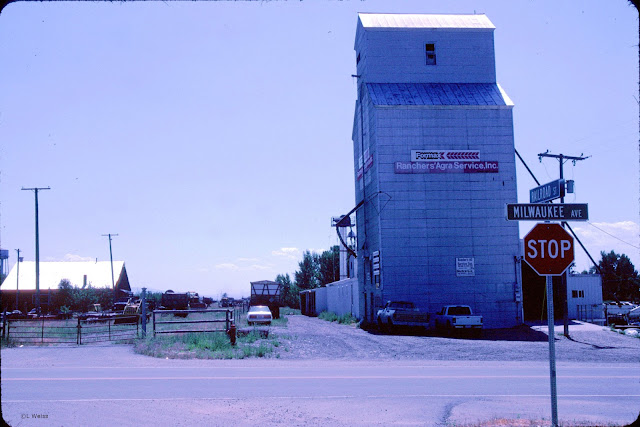
The photo shows the Handel elevator as it looked in July of 2003. Located near the town of Musselshell, MT the elevator stands on this summer day as the Milwaukee's mainline to the west lays dormant at its feet. You can still see the elevator name painted near the top, still see the tall silhouette from afar much as it was when 40 foot boxcars parked near its loading chutes. Days like this summer present an interesting time: the past is visible here, but only for now. The accumulation of years will see to that.

Thursday, August 13, 2009

And the One that Remains

Only a block or so away from the old yards and station of Deer Lodge, MT rests one of the few tributes to the Milwaukee Road and its Lines West electrification. Resplendent in freshly painted orange and maroon, Little Joe E70 sits in the shadow of the old Deer Lodge prison, welcoming visitors from nearby I-90.

The Joe still reflects the power of the Milwaukee's electrification. The lead pantograph is raised and it looks ready to apply 5000 HP to the point of a transcon freight bound for the mountain crossings of Pipestone Pass or perhaps the Bitterroot Range.

This Joe is the only Milwaukee Joe to escape the torch, although examples of this design still exist in Brazil and Illinois from the other lines that acquired them. The spoked drivers are evident on the unit as are a few nods to its original Soviet Union destination. If one looks closely, the mount points for the bumpers that are so prevalent on European rolling stock are still there, nestled behind the large snow plow on the Joe's pilot. These units reflect a unique time in U.S. history: mounting tensions of the cold war, propaganda and fear at home, and a unique railroad that hung wires along its western mountain lines. It is fascinating to consider the journey that this Joe has been on and what the men and women who worked in and around it were a part of.

Compared to its original scope and ambitions, there are few reminders of the Milwaukee's Western Extension. The freshly painted Joe is certainly prominent among its remaining highlights and worthy of some thoughtful consideration.

Friday, August 07, 2009

The Joe that Never Was

The Milwaukee Road was famous for its Western electrification. The wires were strung between wooden poles much like an interurban line and images of Boxcab electrics and Little Joes can be found all over the web. Especially photos of the Little Joe electric locomotives. These 5000+ hp monsters plied the Rocky Mountain Division from their purchase in 1950 until the wires came down in 1974.

The story of their arrival on Milwaukee property is well known, but interesting. Originally destined for the Soviet Union in 1946, they found themselves stranded state side due to mounting Cold War tensions. Legend has it they were named "Little Joe" as a reference to the dictator they almost knew. They sat for 2 years at GE's plant in Erie PA before finding homes. Some were taken to South America, 3 others to the South Shore Electric Line, and the remaining 12 to the Milwaukee Road in 1950. It is ironic that one of the problems the Milwaukee faced with its electrification in 1974 was a lack of electric locomotives. They had the opportunity to purchase the entire lot of electrics from GE in 1948 but passed, and as such, lost a few to the other lines. It seems as though the price was right from GE -- they really just wanted them off the lot, but the demo locomotives proved "slippery" on mountain grades and the power supplied through the overhead wire needed a boost from 3000 to 3300V DC to take full advantage of their pulling power. With these modifications made, the 12 the Milwaukee finally obtained in 1950 proved exceptional units until 1974 and the demise of western wires.

Meanwhile, a few thousand miles away from the Milwaukee's Western Extension, America's other electrified railroads on the East Coast were dabbling with their own variety of electric locomotives. Among them the famous GG1 of the Pennsylvania Railroad. Amazingly these GGs worked for up to 4 railroads during their very long lifetime: The Pennsy, Penn Central, Conrail, and Amtrak. Another entry from GE was the EP-5 electric, nicknamed "Jets" because of their loud blower motors as they raced along the New Haven railroad's lines north of New York City.

As the toy train industry boomed in the 1950s, models of the PRR GG1 and N.H. EP-5 were both well represented by the iconic Lionel corporation. Both models took a few liberties with length (or in the case of the EP-5, length and axle count), but certainly captured the look of the real units. In Lionel's history, it was the N.H. EP-5 that came first in their line of EP-5s, but it was not the last. While the real world limited the use of the Jet to the east coast and the New Haven RR specifically, Lionel saw no need to limit its model to that one particular niche. Proudly following on the heals of the N.H. model, came the Milwaukee Road EP-5 and the Great Northern EP-5. Both pretty models but fantasy in the tradition of toy trains of the period. Instead of Jets, they were even referred to as Little Joes.

Hence, we have the Little Joe that never was. There are some similarities between the Jet and Joe: the cabs have a similar GE style, and at first glance they appear to be quite similar units overall with their dual pantographs and streamlined stylings. The Jet was just a few years newer (1955) and, like the Joe, had ceased being used by the mid 70s. By 1977 all examples were scrapped. They remained thousands of miles apart in the real world: one chewing through miles and miles of mountainous, lonesome terrain and the other on sprints between the big cities of the East Coast. In Lionel world, however, lashups were common.

Tuesday, July 21, 2009

Powder Blues and Old Emblems

The Milwaukee Road had a couple of impressive crossings of the Missouri River. One, located on the Western Extension at Mobridge. The second, located a bit to the south at Chamberlain, SD. These are but two examples of the impressive engineering that went into this old railroad's westward progress.

Chamberlain is a small town in South Dakota in the lands of rolling prairie and tall grasses. Not too far away, a famed author would later recount her days growing up in De Smet as her father worked on building the railroad west in a little house on the prairie. This is that country.

Memories of the Milwaukee are found out in this sea of grasses as well. The old line across this part of South Dakota still rolls along with the gentle hills, but train movements are exceptionally rare.

In Chamberlain rests the remains of many Milwaukee relics from years past. On this day, a pair of old SD-9 locomotives rest silently by the old depot on the outskirts of town. Keeping company are an assortment of dormant switch stands, boxcars, old passenger cars, and some aging company vehicles. The famous tilted rectangle still adorns many of the pieces here in Chamberlain, although it is clear that time is taking its toll and they wear the mark of the fallen. What was one of the preferred colors prominent in the 1970s - that amazing powder blue - is faded and cracked as is the logo on the door. Standing tall in the background, the remnants of another tilted rectangle looks on.

The dilapidation of an old strategic link in the transportation system is quiet and sad in places like Chamberlain. By dynamic contrast, I-90 rolls along outside of town destined for its own crossing of the Missouri River. Its massive 4 lanes and howling all-season radials are anything but quiet and faded blues. At least so far.

Thursday, June 25, 2009

Mists

It is an unsettling feeling to look back at life and ponder the passage of time. It is unsettling to wonder how or why things worked as they did. It has been said that life is a mist, here and then gone. Perhaps the key is to live in such a way that every day is made to count, that every day is meaningful in some way?

In the grasslands of Central Montana, in a small town named Roundup, the mist of the Milwaukee Road's life is slowly dispersing out across the curve of time. The grasses sway and the trees rustle in a warm summer breeze, but the sounds of America's Resourceful Railroad have been gone for many many years. Like the cattle drives that preceded the railroad, lending Roundup its name, quiet is here and life is moving on.

In the tall grasses an old signal stand sits alone with the remnants of a few electrical wires at its base. The insulation is cracked and crusty and their connection to a national lifeline has long been severed. Like other tombstones spread out across the Milwaukee's West, these that remain in Roundup are the fading mists of a line and people who have moved on. A few still stop and take notice of them, but how many? Off the beaten paths, places like Roundup and the Milwaukee Road are where we've been, but somehow, no longer wish to go.

Undeniably, however, these fading signatures of different times still make a difference. I can't explain it, nor even understand it, but I know days I've spent along the route of the Columbian were meaningful and counted for something. I wonder if we would live life differently if we asked ourselves at the end of the day, "what counted today?" It is ironic that even in its life after death, the Milwaukee Road still counts and makes a difference. It fulfills no purpose ever envisioned by those who sent it west, but it remains a difference maker for a few of us nonetheless. On that warm summer day in Roundup, on that day, it made a difference to someone. Now, many years and many miles away, it still does. I guess that's a day that counts for the old girl.

Tuesday, June 09, 2009

Between Mountain Ranges

Location:  Ralston, WA

The lands east of the Cascades and west of the Bitterroots are remarkable in their variety and beauty.  Between these two ranges lie high desert country, rolling wheat fields, foot hills, massive rivers, tumbling sage, abundant wild flowers, rain shadows, endless skies, and a long, long right of way plotted by America's Resourceful Railroad.

To this land between mountain crossings the Milwaukee Road journeyed.  While other parts of the Western Extension existed in near infamy, this land existed in relative quiet.  Like the lands east of electrification, it existed out of the spotlight and away from many photographer's cameras.  The summer heat is harsh and the treeless plains offer little relief.  The winter is cold and the winds have little to break their howl as they roll across the undulating landscape.

The small town of Ralston sits along the right of way here.  It rests beneath Washington skies as the clouds that break apart over the Cascade Range roll out and across this land.  The grasses sway in the summer winds and the grain elevator watches over the small town.  It's a scene that's played out in thousands of places across the West, and many places along the old Resourceful Railway.  The old station has been removed and placed nearby in a farmer's field.  Half of the building is now collapsed and the paint has been missing for many years.  The grasses have taken over much of the old right of way here as well.  Although it remains part of the John Wayne Trail, maintenance is uncommon and use is light.  Much like the days when orange and black locomotives plied the rails, visitors to Ralston are rare.

For those who travel with the Milwaukee Road between the mountain ranges, places like Ralston are a quiet place to stop and ponder.  Apart from the occasional farm truck that rolls by with a wave, this is a lonely journey in a large world.  There is no safety in numbers here - no constant noise from a nearby interstate, no lights to chase away the darkness of long nights.  Now, all of these years beyond the bankruptcy and abandonment, there is no lonely railroad either - just the traveler and that thick feeling of depth that goes beyond what is simply seen.  This is the land between mountain ranges and between electrifications.  In life, and along the Resourceful Railroad, all part of an incredible journey.   

Thursday, June 04, 2009

East of Electrification

Kamm, MT
The end of a hot day in 2003, in the lands east of electrification.  

Monday, May 25, 2009

The Sun Sets West

There was a time, not so long ago, out in the high deserts of Central Washington when the lonesome sagebrush and eerie sunsets weren't quite as alone. Nestled high above the Columbia River in a place named Boylston a railroad built a small station, planted trees, and went about the business of running trains to the West Coast.

The station at Boylston was small and modest, like many others scattered along the rails of The Milwaukee Road. Old photos show Boxcab electrics and infamous Bi-polars climbing the grades here through the Saddle Mountains where Boylston marked the apex. Later photos show SD40-2's pulling hard up these same slopes, the electrification deactivated in the early 70s. The trees are bigger in these later photos and stand in obvious contrast to the desert landscape that surrounds them. This was an outpost on America's Resourceful Railroad, and much like the railroad itself, seemed to exist in spite of the obstacles around it.

Summer in the Saddles still brings hot and dry winds that suck the water out of any creature who braves the midday sun. Tumbleweeds roll across the landscape as they make their way to destinations unknown. The trees planted long ago by a small station named Boylston are tall and remain defiant creatures in this land of sage and sand. But those are the only constants from those old photos. The depot and the railroad have been relegated to memories and that thick feeling of history that beckons from this high outpost above the Columbia River. The sunsets and lonesome sagebrush have returned to the way things were before the railroad got here and that lonseome quiet has returned as well.

But we've got some memories and pictures of a once upon a time, when the sun sank in the west on the old electrified line.

Wednesday, May 20, 2009

Under a Watchful Gaze

In the Pacific Northwest, the Milwaukee Road had an interesting collection of branch lines with equally interesting histories.  Some were not connected to the rest of the system via Milwaukee rails, but with ferries.  Among these isolated lines was the old Bellingham Bay and British Columbia.  This was purchased by the Milwaukee to increase its footprint in the lush Pacific Northwest.  The line operated 25 miles from Bellingham to Sumas on the border with Canada.  Merger conditions that resulted from the Burlington Northern allowed the Milwaukee to do away with its car ferry and access these lines directly.  Despite the light rail, this line was known to be home to some of the Milwaukee's heaviest diesel locomotives as the fleet wore down and the seventies wore on. 

The BNSF still maintains a presence here along these old Milwaukee Lines.  Now that the paint on their locomotives has adopted an orange and black motif, perhaps one could say that not much has really changed.  Compared to other parts of the western extension, I suppose that not much has:  the rail is still in place here, and the sounds of freight trains can be heard echoing across the corn fields as they roam the small north-south line.

On a beautiful summer day like the one pictured, the watchful gaze of Mt. Rainier watches over the cornfields and old Milwaukee rails.  All along the Western Extension, it is the elements that exist beyond the Milwaukee that remain truly constant and seemingly unchanging.  Where rails have been pulled, towns have vanished.  In many places there remains very little evidence that the railroad was ever there.  In many places there is even less evidence of the people who lived along side it.  Nonetheless, constants like Mt. Rainier continue to dominate breathtaking scenery with which the Milwaukee shared space.  Some have argued that the Milwaukee Road traversed the most beautiful scenery on the continent.  Even off the mainlines and away from the haunts of the old electrics, scenes like this seem to bear this out.